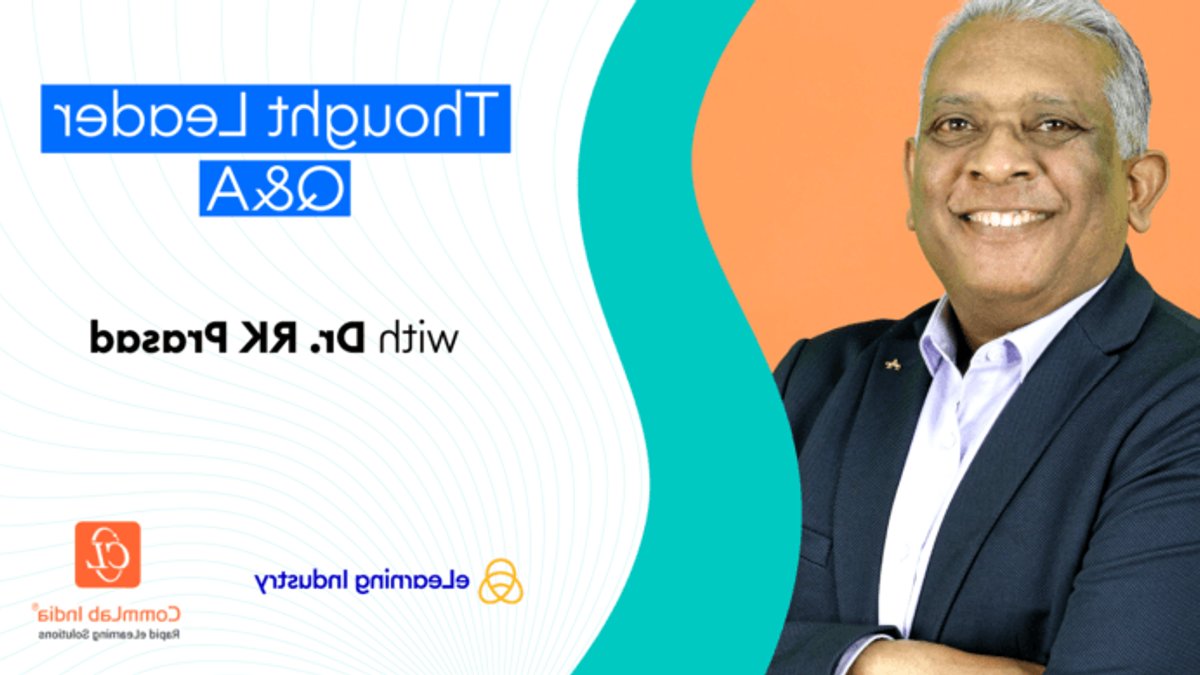
Customer training has evolved from a support function into a key driver of product adoption, retention, and revenue. Companies now face pressure to deliver effective learning at scale as products grow more complex and customer expectations increase.
Dr. RK Prasad, founder and CEO of CommLab India, has spent over thirty years connecting corporate training, eLearning, and customer success. His focus remains on helping businesses ensure customers succeed faster, not just complete training.
From knowledge transfer to customer success
Customer training once consisted of a few videos and a PDF manual. That approach sufficed when products were simpler and expectations lower. Today, it no longer meets demands.
Modern platforms update frequently, and customers expect immediate productivity. They want learning available on demand, in their preferred format, without waiting for scheduled sessions. Prasad explained that the challenge is no longer about training customers but about helping them succeed at scale.
When customers understand a product, they use more features, encounter fewer issues, and rely less on support. The results include faster onboarding, higher satisfaction, stronger retention, and more opportunities for upselling. In this context, training becomes part of the product experience rather than just a support activity.
However, customers have choices. If training is difficult to access, generic, or time-consuming, they will ignore it. Effective customer education must be easy to find, immediately useful, and aligned with the customer journey.
Scaling challenges in training
Most companies can create basic onboarding courses. Problems arise when the business expands—more customers, products, regions, and use cases. What started as a manageable set of resources quickly becomes fragmented.
Different groups need different training. One customer segment may require basic onboarding, while another needs advanced certification. Partners need sales enablement, distributors technical training. Existing customers require product updates, and prospects may seek educational content before purchasing. Managing this manually is not sustainable.
Related: Learning reports lag behind future decisions
The first issue is the operating model. The second is fragmentation. Training materials often exist in PDFs, webinars, support portals, knowledge bases, or employee-focused learning management systems. From the customer’s perspective, the experience becomes confusing and difficult to follow.
The risks to the business are clear: slower onboarding, low adoption of key features, repeated support requests for preventable issues, and reduced customer confidence. Measurement also suffers. Many organizations track course completions but struggle to determine whether trained customers renewed at higher rates or if certification improved partner performance.
As training expands globally, complexity increases. Companies must handle multiple languages, brands, access levels, certifications, and reporting requirements. Treating customer training as a collection of courses is insufficient—it must function as an enterprise capability with the right platform and execution.
For many customers, the difference between a product that feels intuitive and one that feels frustrating often depends on how quickly they can learn to use it. A poorly structured training program doesn’t just delay value—it damages trust in the product itself.
Personalization at scale
Enterprises can deliver personalized training without creating separate courses for every customer. The goal is not to produce more content but to make existing content more relevant.
A new customer doesn’t need the same learning path as an advanced user. A distributor may require technical and sales training, while an end user needs task-specific guidance. Managing these audiences manually becomes costly and inefficient.
A customer training platform or extended-enterprise LMS can automate segmentation, learning paths, and recommendations. These systems allow organizations to group learners by role, account, region, or product, then assign relevant content automatically. AI can further refine this by suggesting resources based on behavior, progress, or past activity.
The benefit extends beyond customers. Personalization should reduce administrative work, not increase it. Companies that succeed in this area rely on reusable content, automation, and AI-driven recommendations. Technology handles routine tasks, allowing learning teams to focus on quality and business impact.
Related: New Approach to Workplace Training Gains Momentum
These systems also help identify gaps in learning progress before they affect performance.
When to upgrade from a traditional LMS
Companies need a customer training platform when learning becomes part of the customer experience and can no longer be managed as an extension of employee training.
Traditional LMS platforms were designed for internal use, such as employee onboarding, compliance, and professional development. Customer education serves a different purpose—accelerating success, adoption, and business performance.
An internal LMS may work when the external audience is small and requirements are simple. As the program grows, limitations become apparent. Common reasons for switching include difficulty supporting multiple audiences, the need for branded portals, role-based access, and manual enrollment processes.
Customer training platforms address these gaps with features like eCommerce, subscriptions, and detailed reporting. They are built to handle the complexity of external audiences—customers, partners, vendors—while maintaining a seamless experience.
The shift involves more than technology. It reflects the recognition that customer training is not a cost center but a driver of growth, retention, and competitive advantage.
Reports often lag behind decisions, making it harder to adjust strategies in real time.
